Monday, 12 March 2012

It was twenty-five years ago today (or thereabouts)

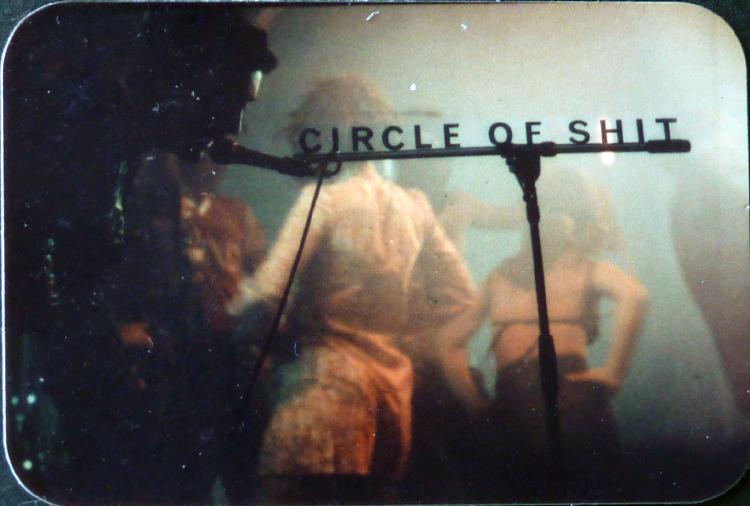
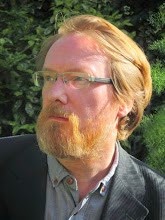
It being my 50th birthday today, I received a gift of a couple of stickers dating back to the late-1980s and the Circle of Shit, the band with whom I used to 'sing'. The other members of the Circle were: Phil Hughes, Millree Hughes, Pete Hewitt and Martin Herring.


Friday, 9 March 2012

Top Ten: Cultural Highlights of 1992

In my forthcoming essay on the lasting legacy of 1992, I shall be discussing at length some all or fewer of the following cultural moments in British life:

1. Men Behaving Badly
The new lad got into his strides on this ITV sitcom, while the BBC was giving women a similar range of role models in Absolutely Fabulous.

2. The Jack Dee Show
The first alternative comedian to reach a mainstream audience without sacrificing his original fan base. Though the John Smith adverts the following year were more influential.

3. Damien Hirst, The Physical Impossibility of Death in the Mind of Someone Living
The moment when the yet-to-be-branded Young British Artists convinced the world that making money should be considered one of the fine arts.

4. Suede in the Melody Maker
‘The best new band in Britain’ get their first magazine cover without having released a record yet, and inadvertently give birth to Britpop.

5. ‘Cherubim and Seraphim’, Inspector Morse
Danny Boyle is in the director’s chair as the Venerable Morse attempts to understand this rave and drug culture on which the youth seem so keen.

6. The death of Lymeswold
Invented by committee as an English brie a decade earlier, this tasteless, cultureless monstrosity of a cheese was finally killed off in a major victory for British food.

7. Morrissey waves a Union Flag at Madstock
He got pilloried by a generation for whom the national flag was a right-wing symbol, but within a couple of years the imagery was ubiquitous.

8. Brian Deane scores the first goal in the Premier League
Manchester United came back from their defeat by Deane’s Sheffield United to win the first Premier League title, to the delight of all those who talked about football as a product.

9. Nick Hornby, Fever Pitch
It changed the cultural status of football and changed the face of literature.

10. Charles and Diana announce their separation
Two colliding views on the nature of modern Britain give up their hopeless alliance and declare war on each other.

Incidentally, the title of the e-book has changed and will now be known as Things Can Only Get Bitter: The Lost Generation of 1992. It'll probably be available early next month.

Tuesday, 6 March 2012

Norman St John Stevas

When you hear on the news that someone who used to be well known has died, a standard response is: Good Lord, I hadn't thought about him/her for years.

Curiously that wasn't the case last night when the death was announced of the generously named Norman St John Stevas, or Lord St John of Fawsley as he later styled himself. He had turned up in conversation only last week when I was talking with Giles Radice about the evolution of the parliamentary select committees - a system that had been launched by Stevas back when he was leader of the House.

That was a pretty impressive legacy for such a slight political figure. Because apart from that, he wasn't really to be taken too seriously. This is an extract from my book Rejoice! Rejoice! Britain in the 1980s:

Thatcher’s determination to get her own way, despite the reservations of so many of her senior colleagues, became ever more apparent as 1981 wore on. She started the year by sacking Norman St John-Stevas as leader of the House, much to the horror of the liberal establishment and at the risk of fuelling his own sense of martyrdom.

‘I argued in the cabinet for a human and compassionate Conservatism,’ he pleaded, though in truth her motivation was rooted not so much in ideology as in a desire to reduce the authority of Francis Pym, the most plausible leader of the wets; Thatcher removed Pym from the ministry of defence and, while keeping him in the cabinet, isolated him as leader of the House, with St John-Stevas simply discarded to make room. As the novelist Michael Dobbs, who worked closely with her, noted: ‘She was ruthless when she had to be – and often when she didn’t have to be as well.’

In a way that was to become characteristic of dismissed wets, St John-Stevas was a couple of months later to be found presenting Dizzy: A Man for All Seasons, a BBC2 programme about Benjamin Disraeli, the man who originated the concept of One Nation Conservatism, in what was presumably intended to be a coded signal about where Thatcher was going wrong. And, as was to become equally characteristic, Thatcher ignored him entirely.

Janice Atkinson-Small

I tend to visit the Daily Mail's website to read specific journalists: mainly the ever entertaining Simon Heffer and Peter Hitchens. This morning I wandered a bit further afield and found myself reading Janice Atkinson-Small, of whom I confess I know nothing.

But she's a gem. This is from her piece about the proposal to introduce gay marriages into British law:

'I am a libertarian believing that people should live their lives freely, not hampered by big State but within the law - and sometimes natural law - which I believe is the union between a man and woman as defined by centuries of tradition.'

That's terrific stuff. She writes like John Prescott speaks.

It's not just the language that gets a bit mangled. Facts take a kicking as well: the government's proposed change 'smacks more of the loony days of Margaret Hodge running Islington and Red Ken in Brent and the GLC'. As I recall, Ken Livingstone was an MP for Brent East but had nothing to do with Brent Council at any stage.

But still, as Ms Atkinson-Small warns, 'the extreme gay lobby will win the day on this one. As have the bullies in the animal rights and pro-life lobbies.' The pro-life lobby? Has it really won the day? Apparently so.

Quote for the Week 14

'We're sitting on a demographic timebomb that successive governments have kept kicking into the long grass.'
- Ruth Porter of the Institute of Economic Affairs, on Radio Five Live this morning

Monday, 5 March 2012

All thro' the House..

It's always slightly worrying when one finds oneself agreeing with Charles Moore, but his article in yesterday's Daily Telegraph does have a point: the NHS really isn't very good, is it?

It's not the worst of the public services - the police clearly have that position sewn up - but, despite all the ritual praise from politicians and broadcasters, for whom it can do no wrong, it's not 'fantastic' at all. Given a choice, I'd rather fall ill in Germany or in France than in England.

Whether the government's reforms will make any difference, I have no idea (nor, indeed, much faith). What I do know is that unquestioningly to defend the status quo means accepting a health service that isn't as good as it should be. It is also an act of political cowardice. And it's the position the Labour Party appears to be adopting.

In this case, it's even more cowardly, of course, because it's obvious that, were there a Labour government, it would itself be busily reforming away. So Ed Miliband keeps quiet about his own opinions, and instead spends his time every week at prime minister's questions delivering a list of professional bodies who don't agree with the government.

Those bodies can speak for themselves, and do frequently. It's not Miliband's job to act simply as the mouthpiece for GPs. It is his job, as leader of the Labour Party, to convince the country that he has some thoughts of his own. Preferably Labour ones.

The benefit of silence is that it allows voters to read into your lack of expressed intention whatever they want. At the moment, this means that Miliband sounds like he's shares the public mood: sentimental loyalty to a system that no other country seems to be rushing to copy. But at some point, he needs to come up with something more substantial.

Doesn't seem very likely, though. It's political opportunism gone mad, I tell you.

Friday, 17 February 2012

Top Ten: Costing the Country

Barely a week passes without the media breathlessly reporting a study that reveals how much a particular activity is 'costing the country'.
So for those who may have missed some of these stories, here's a quick run-down of some recent shock revelations, listed in no particular order.
By my calculation, there's over £160 billion being lost on these items alone, and this is just the tip of the iceberg. Lord knows how big the British economy could really be.


1. Yob culture costs British business £9.8 billion a year - link

2. Black market tobacco costs Britain £2 billion a year in lost taxes - link

3. Alcohol abuse costs Britain £22 billion a year - link

4. Problem families cost Britain £9 billion a year - link

5. Inadequate aviation links may be costing Britain £1.2 billion a year - link

6. Depression costs the country £11 billion a year - link

7. Scrap metal thefts are costing the country £1 billion a year - link

8. ID fraud is costing Britain £1.7 billion a year - link

9. Post-Christmas blues cost British firms £93 billion a year - link

10. Failure to rehabilitate ex-offenders costs the country £10 billion a year - link

Monday, 13 February 2012

We Need to Talk about Kevin

I don't normally approve of old bands getting together again, let alone of them releasing new material as though we're interested in anything other than nostalgia.

But Dexys Midnight Runners are different. They released so little material - just three albums and a handful of non-album tracks - that anything would be welcome.

I first saw them back in 1980, supporting the Specials at the Lyceum, and saw them most recently a few years back for a reunion gig at the Festival Hall. And they're simply magnificent.

I've never experienced anything quite like that last gig - the sense of trepidation when the lights went down, as if the whole audience had stopped breathing so they could pray for Kevin Rowland, and then the sheer relief, the joy and the love, when he came on stage and was so evidently sane, sharp and on top of his game. And his image, dressed like a Marseilles sailor in the 1930s, was wondrous. Which is important, because this is Kevin Rowland we're talking about.

So I can't keep a huge grin from my face, as I hear the opening couple of minutes of the new Dexys album and realise that they still possess the kind of beauty that no one else gets near:

Saturday, 11 February 2012

Annus Horribilis

I've just signed a contract with Aurum Press for an e-book. Or possibly an e-essay - I'm not sure what the correct terminology is. It's a slightly odd format: a 25,000-word piece, too long for magazine publication, too short for a book, but perhaps just about right for download. In any event, I like the length of it: an hour or so's reading available for a couple of quid.

As the above rambling suggests, I have already pretty much written the piece, though it'll take another month or so before it's available. I'm hoping it'll be published in March to commemorate my fiftieth birthday. Because that's kind of what it's about: the political and cultural story of my generation, hinged on the 1992 general election and the impact that John Major's victory had.

Just to pay proper tribute: this originated in an entry in Dan Atkinson's blog on the Mail Online site last year. He noted the paucity of senior politicians born in the early 1960s, and my piece is an attempt to explain this phenomenon.

So there it will be. Annus Horribilis: The Lost Generation of 1992. Available in all good e-bookstores shortly.

Friday, 10 February 2012

Mr Wonderful Takes a Cruise - a review


Even for those with a passing interest in Westminster politics, John Nott is hardly the most evocative of names.

He's remembered as the defence secretary who resigned after Argentinian troops forcibly occupied the Falkland Islands, and for the interview with Robin Day in which he, quite reasonably, took exception to Day's pompous cynicism and walked out of the studio. And, er, that's about it, isn't it? A vague memory of an ascetic looking Thatcherite, perhaps?

Clearly I should have read his memoirs - Here Today, Gone Tomorrow - but I haven't. So I came to his book Mr Wonderful Takes a Cruise: The Adventures of an Old Age Pensioner (Ebury Press, 2004) with no real preconceptions. And it's an unadulterated joy.

Nott and his wife have decided to go on a cruise around the Norwegian fjords, so he resolves to brush up on his ballroom dancing and his bridge-playing, while simultaneously carrying out a study of the mores of modern Britain. He wanders around Shepherd's Bush Market, enjoys a lap dance in Spearmint Rhino and samples youthful enthusiasm in an evangelical church.

All of which is accompanied by a humane, tolerant commentary shot through with a level of ironic wit that I don't think I've ever encountered from a politician before. It's really very, very funny indeed. I particularly like his shocked response when told that if he takes Viagra and finds he has not reverted to a 'natural state' after four hours, he should go to his doctor: 'My God!' he replies. 'It would be highly embarrassing for a member of Her Majesty's Most Honourable Privy Council to walk to the surgery down Sloane Street in an engorged state.'

The cruise itself is something of a disappointment to Nott, but it does allow him to fantasise about his Viking roots (he insists that his surname derives from that of King Cnut) and about his forthcoming reclamation of the British throne. He'd like to stake his claim through peaceful mean, but is aware that force may yet be necessary, which provokes my favourite line in the book: 'With Erik Bloodaxe and Harald Hardrada in my pedigree, I have inherited a concealed talent for violence.'

And his conclusion, after two hundred pages of examining the state of the nation? 'The elderly must not become old Grundys, deploring the modern world, saying that the country is not what it was. It never has been. The world goes on its own way whether the old and critical approve of it or not.'

This is tremendous stuff. As entertaining and wise a book as I've read in a very long time.

Tuesday, 7 February 2012

Let Us Now Praise... Giles Radice

Since listing my favourite political diarists a couple of weeks ago, I've been reading Giles Radice's Diaries 1980-2001 (Weidenfeld & Nicolson, 2004). And they're really very good - certainly they would have featured in my top ten had I read them earlier.

I always had a lot of time for Radice, a Labour MP from the social democratic wing who didn't leave for the SDP, instead staying to fight his corner and to attempt the recapture of the party from the left. It all seems a terribly long time ago now, but Radice was then in his mid-forties and approaching his political prime - his departure would have been a serious blow to Labour.

As it was, he ploughed a very lonely furrow through much of the 1980s, resisting an attempted Militant takeover of his constituency party and holding fast to a set of beliefs that were deeply unfashionable.

Elected as an MP in 1973, he was still in the Commons twenty-one years later when Tony Blair became leader and began to implement many of the changes he had long argued for. His relentless espousal of European integration and his argument, in the Southern Discomfort pamphlets, that Labour had to start addressing affluent and aspirational voters in the south, as well as its core supporters in the north, were hugely - if quietly - influential.

In the Diaries he quotes Tony Blair telling him that he was 'a Blairite before Blair', which is probably about right, so long as one can separate Blairite revisionism from Blair the prime minister.

Radice never served in government, but he did play a significant role in developing the role of parliamentary committees. He also wrote the excellent Friends and Rivals (Little Brown, 2002), a triple biography of Tony Crosland, Roy Jenkins and Denis Healey, which is one of the great studies of the social democratic tendency within post-war Labour.

He describes himself as being 'uncharismatic', which is probably true. He is, however, something of an unsung hero. And he had a fabulous head of hair.

Monday, 6 February 2012

Quote for the Week 13

'Those who haven't come up with the answers before should stop attacking those who are producing solutions.'
- David Blunkett slaps down Roy Hattersley in 1995